
10 Easy English Short Stories (A2) with Questions and Answers
A key that will not turn. A photo with nobody in it. A first day at work. These 10 short English stories for A2 learners start with familiar situations and give you a small problem to follow.
Each story in the reading library has three comprehension questions, correct answers and explanations. You can read without an account, translate unfamiliar words and save vocabulary to practise. The first story and its questions are also included below, so you can try the level immediately.
1. The Key in the Envelope
A neighbour needs help. Tom has the key, but something is wrong. Read the story once before answering the questions. You do not need to translate every word to understand what happens.
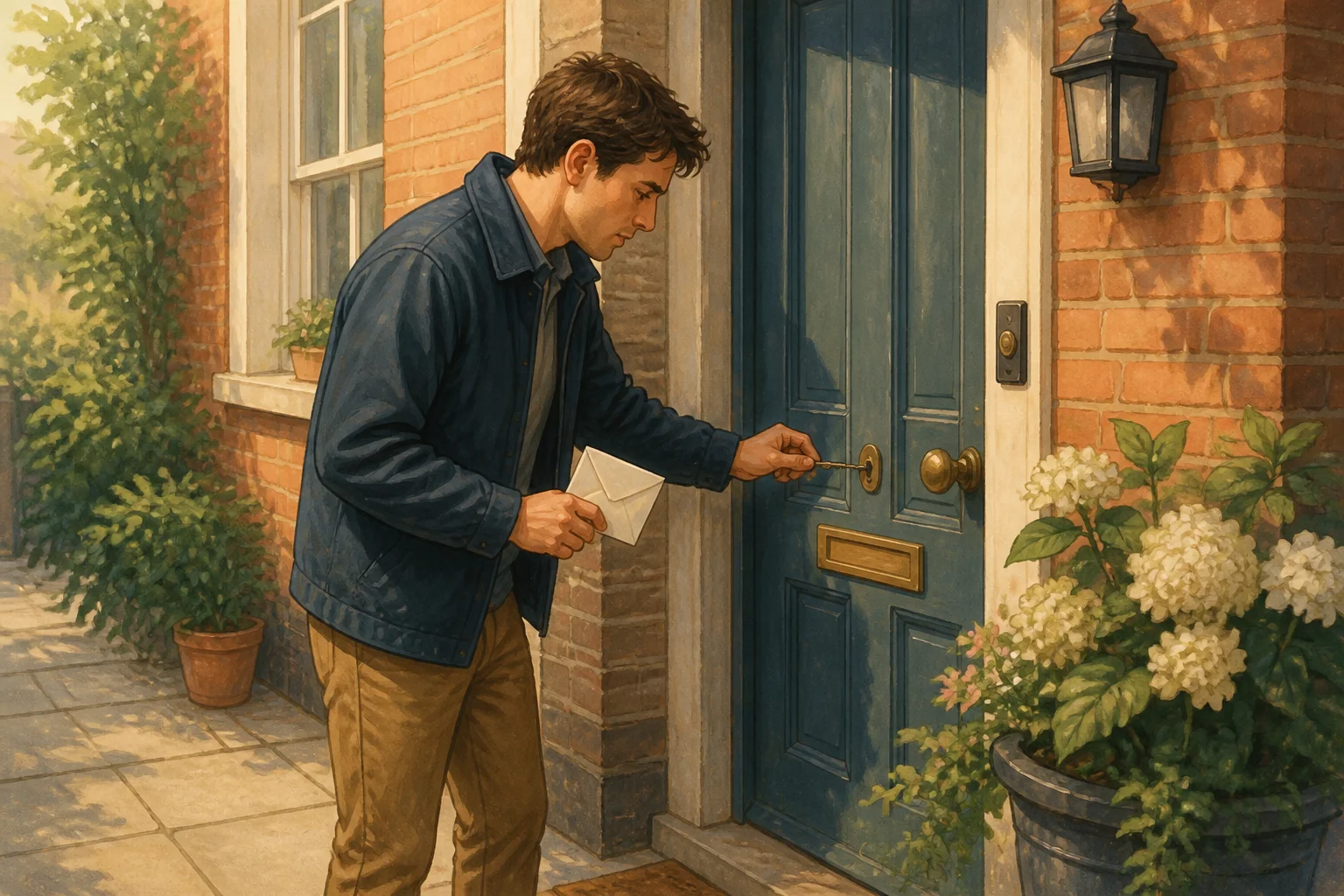
Before Mrs Reed went away, she gave Tom an envelope. "The key is inside," she said. "Please water my plants on Wednesday."
On Wednesday evening, Tom took the key upstairs. He tried it in her front door, but it did not turn. He tried again, more slowly. Nothing happened.
Tom called Mrs Reed. She answered from a busy railway station. "Is there a small red circle on the key?" she asked.
"Yes."
"Oh dear! That's the key to my garden gate. The door key is in the envelope too."
Tom looked inside again. A second key was under a folded piece of paper. On the paper were three short instructions about the plants.
This time, the door opened easily. Tom watered the plants and left the instructions on the kitchen table. Then he wrote himself a note: "Next time, read everything first."
Three useful words
- envelope — a paper cover used for a letter or other small items.
- gate — a door in a fence or wall, often leading into a garden.
- folded — bent so that one part lies over another part.
Check your understanding
1. Why did Mrs Reed give Tom the envelope?
- A. To collect her letters.
- B. To look after her plants.
- C. To repair her gate.
2. What did the first key open?
- A. The garden gate.
- B. The front door.
- C. A kitchen cupboard.
3. Where was the second key?
- A. At the station.
- B. Under a plant.
- C. Under a folded piece of paper.
Show answers and explanations
- B — To look after her plants. Mrs Reed asked Tom to water them while she was away.
- A — The garden gate. Mrs Reed recognised the key with the red circle and explained what it opened.
- C — Under a folded piece of paper. Both keys were in the envelope. Tom found the second one when he looked again.
Missed an answer? Find the sentence that explains it, then read that part again. For word translations and the interactive quiz, open The Key in the Envelope.
Choose your next A2 story
The nine stories below each include a three-question quiz with answers and explanations on their reading page. Choose a situation that interests you; there is no required order.
2. The Photo with No People
Rosa is helping her grandfather organise family photographs. One picture shows an empty kitchen. Why would anyone keep a photograph with no people in it?
This is a quiet story about family memories. Watch how the meaning of the picture changes as Rosa learns more about it.
Vocabulary to notice: album (a book for photographs), drawing (a picture made with a pen or pencil), carefully (with attention).
Read The Photo with No People and try its questions.
3. A Week without a Phone
Amir breaks his phone and has to wait a week for the repair. Bus journeys, finding a cafe and waking up on time suddenly require different solutions.
Try this story if you enjoy everyday situations. As you read, notice what Amir does differently and which changes he keeps afterwards.
Vocabulary to notice: repair (make something work again), borrowed (took something to use and return), route (the way from one place to another).
Read A Week without a Phone and try its questions.
4. The Six O'Clock Swim
Elena wants to feel more comfortable in the water before a holiday. Her first swimming lesson starts very early, and the pool looks much longer than she expected.
The story gives you practice with feelings and small changes: being afraid, feeling less worried and looking forward to something.
Vocabulary to notice: deep (a long way from the surface to the bottom), steps (surfaces you use to go up or down), worried (feeling that something bad might happen).
Read The Six O'Clock Swim and try its questions.
5. A Cake for the Driver
A village bus driver is retiring. His passengers prepare a cake and a card to thank him, but carrying a cake on a moving bus is not easy.
Read this one for a warm community story. Pay attention to the difference between the gift Lily planned and what the driver actually receives.
Vocabulary to notice: passengers (people travelling in a vehicle), retirement (the time when someone stops working, usually because of their age), gently (in a soft or kind way).
Read A Cake for the Driver and try its questions.
6. The Market Jacket
Max buys a second-hand jacket and finds a note in its pocket. It gives a meeting place and a time, but no name or date. He takes it back to the market to ask about it.
Choose this story if you like a small mystery. Look for the detail that explains why an old piece of paper matters to someone.
Vocabulary to notice: second-hand (previously owned by another person), pocket (a small space sewn into clothing), stall (a place where someone sells things at a market).
Read The Market Jacket and try its questions.
7. The Night Bakery
Rob begins his first bakery shift at eleven at night. He wonders who needs bread at that hour. As customers arrive, he discovers a part of the town he has never noticed.
This story is useful for practising times, jobs and the order of events. Notice who arrives first, who comes later and when Rob finally goes home.
Vocabulary to notice: shift (a scheduled period of work), dough (the mixture used to make bread), loaf (bread baked in one piece).
Read The Night Bakery and try its questions.
8. The Long Way Home
Bea's usual cycling route is closed for repairs. The longer journey annoys her, but a small shop along the way turns out to be useful.
Follow the reasons for each change in Bea's journey. Why does she take another route? Why does she stop? Why does she feel differently the next day?
Vocabulary to notice: brakes (parts that slow or stop a bicycle), noticed (saw or became aware of something), extra (more than the usual amount).
Read The Long Way Home and try its questions.
9. The Empty Shop Window
Ada thinks an unused shop window could become a place for local art. She asks the owner, invites her neighbours and waits to see whether anyone will take part.
Choose this story for vocabulary about your neighbourhood and making plans. Compare what Ada expects with what actually happens.
Vocabulary to notice: owner (the person something belongs to), invited (asked someone to come or take part), comments (things people say or write about something).
Read The Empty Shop Window and try its questions.
10. The Dinner Practice
Noah is about to start work as a waiter. His family helps him practise taking orders, but they change their minds and ask extra questions. He needs a better way to remember everything.
This is a good choice for restaurant vocabulary. Look for the two practical changes Noah makes before his first day at work.
Vocabulary to notice: waiter (a person who serves customers in a restaurant), ordered (asked for food or drinks), repeated (said something again).
Read The Dinner Practice and try its questions.
How to use a short story for English practice
You can use this routine with any of the stories:
- Read for the situation. Who is the story about? What problem do they have? Keep going if one unfamiliar word does not stop you understanding.
- Check a few useful words. On the interactive reading page, select a word to see its translation. Save words you would like to use yourself.
- Answer the three questions. Try before checking the answers. When you get one wrong, find the sentence that supports the explanation.
- Tell the story in two or three sentences. You can say it aloud or write it down. For example: "Tom wanted to water his neighbour's plants. He tried the wrong key. Then he found another key in the envelope."
- Return to your saved words. Review them in Saved Words, then use one in a sentence about your own life.
Start with one story. You can read another when you want more practice; you do not need to finish all ten in one sitting.
Questions about A2 reading practice
Are these stories suitable for beginners?
They are intended for A2 learners who can already follow some short English texts about familiar situations. The level labels are guides, not a test result. Try the sample above: if following the basic events is difficult even with translations, start with the A1 story collection.
Are the stories and questions free?
Yes. You can read these library stories and answer their quizzes without a subscription or an account. They are ready to read; you do not need to generate an AI text first.
Should I translate every unfamiliar word?
Try reading the sentence first. If you still cannot understand an important action or detail, check the word. You can also translate a word simply because you want to learn it. Aim to finish the story and understand what happened, rather than turn every sentence into a long vocabulary list.
What should I read after these stories?
If these feel comfortable, try the B1 stories. If you prefer facts to fiction, explore the articles in the reading library. You can also turn words you have saved into a new practice text: this guide explains how to create AI stories with your own vocabulary.
Start learning on LearnMovies